The Darrieus wind turbine is a vertical axis turbine used to produce electricity from the force of the wind . It takes its name from the French engineer Georges Jean Marie Darrieus who filed the patent for this invention in the United States of America on October 1, 1926 and obtained it on December 8, 1931.
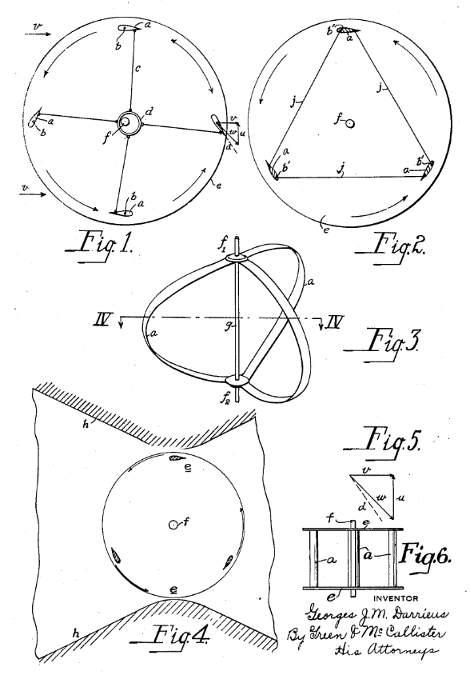 The diagrams provided by Georges Jean Marie Darrieus in his patent application
The original blade design (as seen in Figure 3 of the patent) of the Darrieus wind turbine consists of three curved blades arranged in a triangle around a vertical axis. These blades can actually be used in pairs, and their curvature is now optimized according to the troposkine shape to best mitigate the mechanical stresses generated by the rotating structure. Darrieus wind turbines can indeed withstand winds of up to 220 km/h. Following the 1995 invention of the helical turbine by Alexander Gorlov, intended for hydroelectric power but which is clearly an extension of the Darrieus invention, Darrieus-type wind turbines have been improved by the helical shaping of the blades, twisted at 60°. This reduces rotor vibrations. Furthermore, the noise level of Darrieus wind turbines is further reduced. Not to mention the aesthetic improvement and commercially appealing visual appeal.
Vertical wind turbine with rotating structure
The vertical rotating structure of Darrieus wind turbines , which therefore do not need to be oriented towards the wind, offers the distinct advantage of being able to capture wind from any direction. However, the blades of a Darrieus turbine, by their very operating principle, cannot start on their own; the weight of the entire rotor assembly exerts pressure on its base. This is why this type of wind turbine requires a starting mechanism. Several options exist. This can be achieved using an electric motor, of course, or by combining it with a Savonius wind turbine, which offers significantly better autonomous starting.
Darrieus wind turbine, yield
The low efficiency of Darrieus wind turbines is partly due to the weight of the rotor on its stator and the resulting frictional forces that must be overcome. However, this low efficiency is compensated , as we have just seen, by the omnidirectional wind-catching capacity of Darrieus wind turbines.
Another important advantage of this type of wind turbine is that the electric generator is located at the base of the turbine, on the ground. This eliminates the need to invest in building a tower (although this proximity to the ground is a significant reason for the lower efficiency of this type of turbine, as other types of wind turbines require the blade tips to be at least 40 meters above the ground for optimal efficiency). Most importantly, this significantly reduces and simplifies the installation cost and long-term maintenance of the wind turbine.
The largest Darrieus wind turbine experiment took place in Quebec between 1983 and 1992 under the name Eole Park. An extremely strong windstorm brought the experiment to an end.
See also:
Our facilities and achievements.
Everything you need to know about the Savonius wind turbine.