 Wind power, definition
Energy produced from the force of the wind on the blades of a wind turbine . When the wind blows, the forces acting on the blades cause the rotor to rotate. The electrical energy thus produced can be distributed to the electrical grid.
Wind farm in Charente
We speak of wind farms for large wind turbines (>20m high and 36kVA).
Wind energy, how it works
Wind energy is a source of energy that depends on the wind . The sun heats the Earth unevenly, creating areas of different temperatures and atmospheric pressure around the globe. These pressure differences generate air movements, which we call wind. This energy is used to generate electricity in wind turbines , also called wind generators , thanks to the force of the wind.
Horizontal wind turbine / vertical wind turbine
Wind turbines rotate either around a vertical or a horizontal axis . Most wind turbines currently in operation have a horizontal axis. Current research efforts are focused on developing vertical-axis wind turbines . This would eliminate the need to orient them into the wind, as they offer the same cross-section in all directions. However, this characteristic presents a disadvantage, since in the event of a storm, it would be impossible to protect the rotor to reduce the force applied to it.
There are three main types of vertical axis wind turbines : the differential drag panamones, the Savonius propeller or “S” rotor, and the Darrieus wind turbine .
The Savonius rotor comprises two, and sometimes even three, curved blades intersecting around a central axis between two end caps. Its operating principle relies on the combined use of differential drag and lift.
The Savonius rotor gained popularity as a device that was easy to assemble on-site using very simple means. However, this simplicity is more apparent than real. Significant problems can arise when installing the inevitably heavy rotor on the bearings, as well as when coupling the turbine’s vertical shaft to a positive displacement pump (because its rotational speed is too low for coupling to a centrifugal pump). Furthermore, the main drawbacks of the Savonius rotor wind turbine are twofold:
- Its efficiency is poor, and its manufacture requires a significant amount of material due to its large size. This results in a less favorable cost-effectiveness ratio compared to other types of rotors.
- It is difficult to protect it against overspeeding in the event of a storm and its being blown apart.
The Darrieus wind turbine is equipped with blades whose lifting cross-section is shaped similarly to airplane wings. These blades can be straight, in which case the machine would have an H-shaped profile. However, in reality, most wind turbine blades of this type are shaped like an “eggbeater” or a “troposkian” profile, as shown in the figure. The choice of this shape is mainly explained by the fact that the centrifugal force due to rotation would tend to bend straight blades, whereas the troposkian or jump rope profile of curved blades offers greater resistance to bending stresses. Vertical-axis turbines of the Darrieus type have very high efficiency , since their operation relies solely on the use of the lift forces created by the interception of the wind by the blades. Because they rotate at a speed three to five times greater than that of the wind, the wind direction will make a sufficiently small angle with the surface of a blade to produce lift rather than drag. The Darrieus wind turbine was preceded by another, much more rudimentary , vertical-axis wind turbine with a triangular sail, used in the Turks and Caicos Islands in the West Indies. This device provides a better illustration of the operating principle of the Darrieus wind turbine , as it clearly shows how the triangular sails generate motive force when they intercept the wind, just like a sailboat. In fact, the Darrieus wind turbine operates on exactly the same principle.
Wind power, the advantages
 A wind turbine has several advantages:
– It is a renewable energy source that requires no fuel;
– Does not produce greenhouse gases or any products harmful to the environment (for both soil and air);
– Low production cost compared to the energy produced;
– It is a decentralized energy source close to the user (very low losses during the transport of energy to the consumer).
– Occupies a small area of ground;
– The system is modular according to the need, and is fully demountable or recyclable;
– Installed in the right place and properly oriented, it can quickly become profitable and cost-effective by lowering your electricity bill;
– Possibility of selling the surplus to EDF;
– Return on investment in the medium term;
– The period when a wind turbine produces the most is winter when the winds are strongest, perfectly corresponding to the period when energy demand is highest;
– THE RECYCLABILITY RATE IS 98%, MAKING IT ONE OF THE MOST ECOLOGICALLY RENEWABLE ENERGIES ON THE MARKET.
Wind power yield
The efficiency of a wind turbine is difficult to assess because it depends on variable parameters such as wind speed at the installation site. A wind energy engineering firm should conduct a study before installing a wind turbine . An average overall efficiency can be calculated, which is the ratio of electrical energy produced to the energy input from the wind. It is generally around 20% for small wind turbines.
Wind energy: the negative impacts
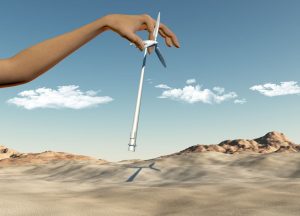 A wind turbine has many advantages, but it is subject to debate regarding its negative impacts.
Firstly, there is the noise pollution , which has decreased significantly over the years (for example, through the elimination of mechanical noise ). The noise of a wind turbine consists primarily of the sound of the blades cutting through the air . In fact, it is mainly the noise created by the tips of the blades. Over the years, manufacturers have refined the design of the blades to minimize noise emissions, particularly with vertical-axis wind turbines , which are known for their quiet operation and good performance in turbulent winds.
To put all this into perspective, a domestic wind turbine in good condition is very quiet : it emits about 40 dB, which is about the same as the wind in the trees or even that of a modern refrigerator.
Furthermore, a wind turbine can also represent a visual nuisance due to its size or design.
It’s important to know that a wind turbine has a simple, aerodynamic, and streamlined design (particularly due to its white color). Whether or not it’s considered a nuisance is subjective: some will find it unsightly, while others won’t mind.
Paradoxically, modern man accepts in his landscape several elements essential to modern society such as highways, high-voltage power lines, water towers, radio/telephone transmitters, etc.
So why not integrate wind turbines? Especially since they are part of the energy transition and sustainable development process.