It was in 1924, practically at the same time that Georges Jean Marie Darrieus filed his patent for a vertical-axis turbine , that Sigurd Savonius, a Finnish architect whose mind was much more that of an engineer and inventor, developed a vertical-axis wind turbine whose principle now bears his name: the Savonius rotor . His patent for it was filed in 1929.
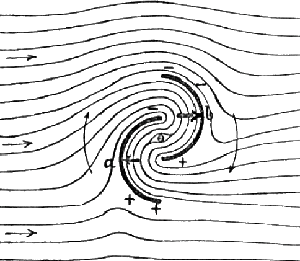
An original drawing by Sigurd Savonius
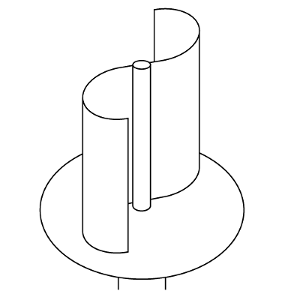
Its principle is quite simple: two half-cylinders placed in opposite directions on a vertical axis form buckets. Viewed from above, the Savonius rotor in its most basic form traces an S shape . Wind rushes alternately into these buckets, thus rotating the axis to generate electricity . Technically speaking, its principle is based on an aerodynamic torque induced by the airflow within the structure created by Savonius.
Although vertical axis wind turbines (often abbreviated as VAWT in specialized literature) are less common than horizontal axis turbines, their advantages are numerous. In the case of the Savonius wind turbine , its compact size and low noise level are particularly striking, and it offers, in these two respects, a high degree of discretion once integrated, even in dense urban environments.
From an operational standpoint, it starts up and begins rotating (and therefore generating power) easily, even in light winds. This quality is lacking in the Darrieus wind turbine; this is why the former is often combined with the latter in a hybrid wind turbine to act as a starter. It also offers good independence from wind direction, giving it a distinct advantage over horizontal-axis wind turbines (also categorized by the Anglo-Saxon abbreviation HAWT , for Horizontal Axis Wind Turbine , as opposed to VAWT , which we defined earlier).
In addition to its basic qualities, the original Savonius rotor was given a helical shape to optimize wind capture by making it continuous. This is how the resulting helical Savonius wind turbine has become so widespread in contemporary architecture. It is indeed easy to integrate onto a building, a roof, or even atop a street light, for example, and can even be coupled with solar panels . The eye-catching movement of the Savonius wind turbine , enhanced by appropriate coloring, is used for commercial and advertising purposes.
Despite their advantages, Savonius-type wind turbines have weaknesses. Firstly, the significant mass of the rotor results in low efficiency due to induced inertia . But the very principle of this rotor is also a factor, since the blade presenting its convex face to the wind is, by definition, not as efficient as one presenting its concave face to the wind at the same time. However, when cost and, above all, the reliability of the installation take precedence over efficiency, it remains a good choice.
To have:
Our Savonius helical type wind turbines.
Everything you need to know about the Darrieus wind turbine.